Born from Spider Webs and Royal Ambition
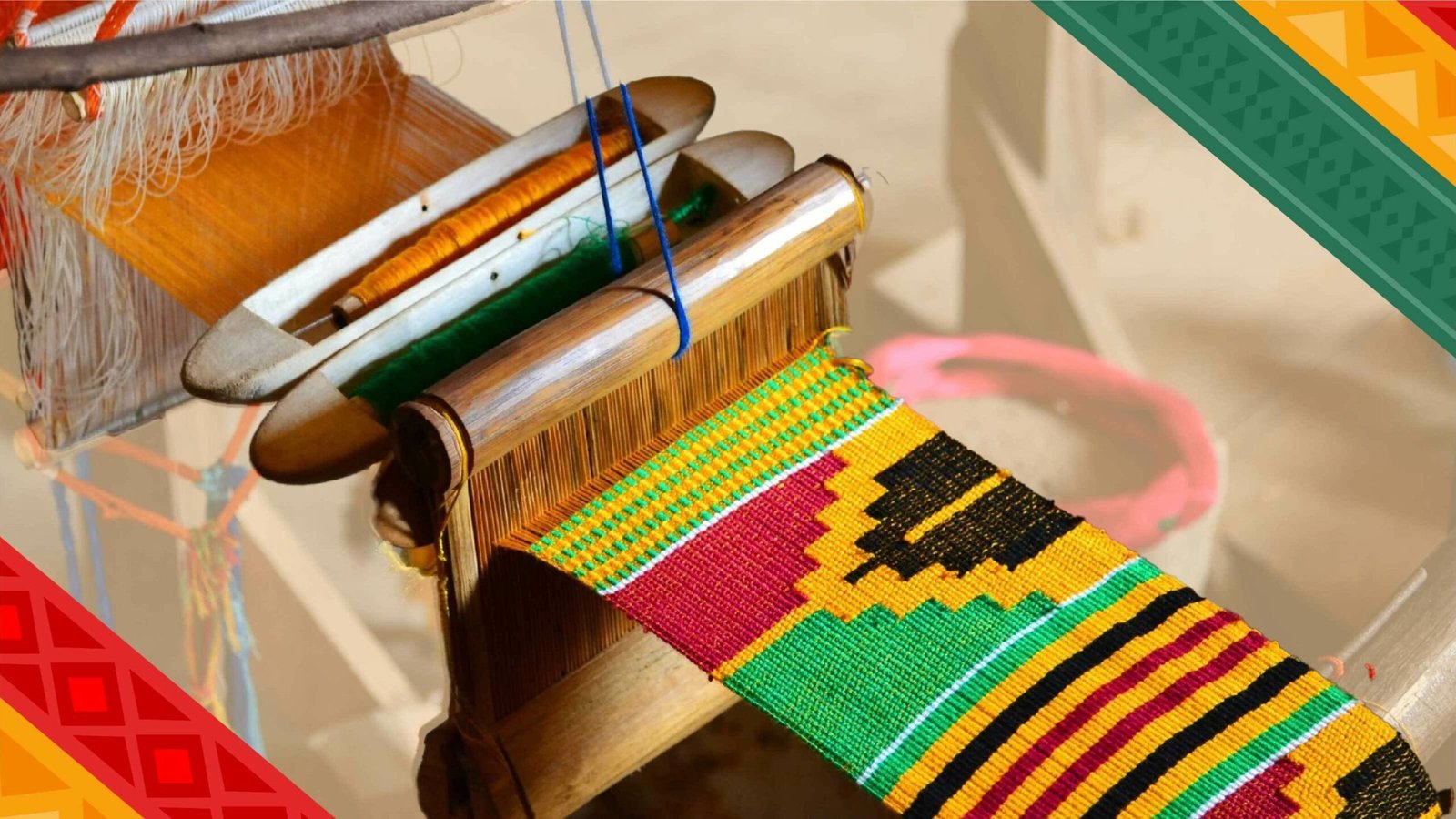
When spider and loom conspired in a forest clearing near Bonwire village during the reign of Osei Kofi Tutu I in the late seventeenth century, they wove more than fabric; they wove a language. Three Asante men, Kuragu, Ameyaw, and Ota Karaban, watched the silk threads of a web catch morning light, and something ancient stirred. They returned to their village with knowledge of interlocking patterns that would become Kente, a textile so imbued with meaning that to wear it is to speak without opening one’s mouth. Today, this sacred cloth has travelled from the courts of Ashanti kings to UNESCO’s Representative List of Intangible Cultural Heritage, where it was inscribed in December 2024. In September 2025, Ghana secured the first Geographical Indication status for an African textile, complete with QR codes for authenticity verification. Kente has arrived at a remarkable inflexion point, simultaneously protected by international law and gracing runways from Lagos to Paris.
The Akan word nwentoma “woven cloth” captures what Kente fundamentally is, while kenten, meaning “basket,” describes the technique that makes it distinctive. Archaeological evidence traces handloom weaving in southern Ghana to the fourteenth century, with spindle whorls discovered at Begho dating the practice to the sixteenth century. But the colourful cloth we recognise as Kente crystallised during the seventeenth century under Asante patronage.
The oral histories diverge here, as they often do with treasures worth claiming. Asante tradition credits weavers from Bonwire with introducing the loom from Bono Gyaman. At the same time, an alternative narrative insists the craft emerged independently in Bonwire, inspired by those who watched spiders work. The Ewe people of the Volta Region maintain their own competing claim, tracing their weaving traditions to the 1500s when migrants arrived from Benin and Nigeria. What remains undisputed is that both Asante and Ewe weavers developed distinct traditions, producing cloths of such sophistication that early European observers struggled to comprehend how narrow strips from simple looms could yield such complexity.
The original Kente emerged from raffia tree fibres in black and white only, before ambition intervened. As the story goes, when early weavers presented their work to the Asantehene, he suggested more colours would enhance its beauty. This royal commission sent weavers searching for plant dyes: indigo for blue, cam wood for red, tamarind for brown, spinach for green. The transformation accelerated dramatically when Portuguese, Dutch, and Danish traders began bringing silk fabrics from Europe and Asia. Asante weavers would purchase these imports and carefully unravel them, reweaving the silk threads into their own patterns, a practice documented by Danish agents observing the court of Asantehene Opoku Ware I between 1720 and 1750.
The Vocabulary Woven in Threads
To understand Kente is to learn a language in which colour speaks and pattern narrates. Gold signals royalty and wealth; yellow carries beauty and fertility; green evokes renewal and harvests; blue embodies harmony and peace. Red pulses with passion but also bloodshed, worn to funerals as much as festivals. Black represents maturation, ancestral energy, and the deepening of spiritual presence. White offers purity, while maroon grounds everything in Mother Earth’s healing embrace. An elephant woven into the cloth announces kingship; a scorpion warns of bitterness.
The most prestigious pattern carries a name that requires explanation: Adwene asa, meaning “my skills are exhausted.” According to elders, a weaver once attempted to create a cloth so exceptional it would satisfy the Asantehene himself. In his effort, he incorporated every known motif into a single textile geometric shields called akyem, zigzag nkyinkyim representing life’s unpredictable path, references to python heads and butterflies. When finished, he had nothing left to give. This cloth remains the most expensive Kente pattern, woven only for kings, requiring three heddles instead of the standard two and produced by a select few master craftsmen.
The pattern called Fathia Fata Nkrumah carries a more political history. When Ghana’s first president, Kwame Nkrumah, married Egyptian Fathia Rizk in 1957, some Ghanaians initially protested his choice of a non-Ghanaian bride. Market women, however, welcomed her warmly, renaming an existing pattern in her honour “Fathia is a fitting wife for Nkrumah.” The cloth’s nine squares represent mpuankron, the ceremonial haircut of royal advisors who assist rulers in decision-making. Its original name, Baako Mmu Man (“one person does not govern a nation”), spoke to participatory democracy. After Nkrumah’s 1966 overthrow, some attempted to restore the original name, but Fathia Fata Nkrumah persists cloth remembers what politics tries to forget.
Scholars estimate approximately fifty core traditional patterns exist, though variations and newer designs number in the hundreds. Each tells a story. Sika Fre Mogya (“money calls blood”) comments wryly on how relatives appear when wealth does. Emmaa Da (“it hasn’t come before”) celebrates the unprecedented moment when blue dye was first added. Kyeretwie honours an Asantehene brave enough to catch a leopard.
Where Looms Still Click Against the Afternoon
The village of Bonwire remains Kente’s heartland, eighteen kilometers from Kumasi on the road to Mampong. Here, hundreds of weavers continue working at horizontal looms called Nsadua Kofi, “Kofi, the Creator’s loom,” their feet pressing wooden treadles while their hands shuttle weft threads through warp. Each strip emerges four inches wide and several feet long; twenty to thirty strips must be sewn together to complete a single cloth. A complex piece requires days or weeks of labour.
In January 2024, the Bonwire Kente Museum opened its doors, featuring exhibition spaces, demonstration areas, and a showroom where visitors watch master weavers work. The exterior bears Adinkra symbols; the interior displays historical designs alongside photographs of global figures wearing Kente. The nearby villages of Sakora Wonoo, Ntonso, Safo, and Adanwomase maintain their own traditions. Adanwomase holds particular significance as the royal weaving village for the Asantehene since 1697, housing approximately 2,500 residents involved in Kente production and keeping the sacred Seseε, a basket containing samples of every historical pattern.
In the Volta Region, Agotime Kpetoe serves as the heart of Ewe Kente weaving, where roughly 95 per cent of inhabitants maintain looms in their homes and children learn the craft from age four. The annual Agbamevorza Festival, celebrating Kente since 1995, draws visitors each August, with the 2024 edition running August 4-11 under the theme “Repositioning the Kente Heritage for Inclusive Development.” At Agbozume, the largest Kente market in the region, the Ahiagble family carries forward a multi-generational legacy. Gilbert “Bobbo” Ahiagble, who passed in 2012, remains the most famous Ewe Kente weaver of recent history; his sons, Bob Dennis and Jeff Bill, now continue his mission, collaborating with international designers while preserving techniques such as novi-akpedo and tritriku that fewer clients commission.
The question of who weaves Kente remains culturally complex. Traditionally, weaving has been an exclusively male practice, with menstrual taboos cited as justification. Anthropologist R.S. Rattray documented in 1927 that a menstruating woman could never touch a loom, and that a woman who weaved would never bear children. Contemporary scholars suggest this may reflect economic competition as much as spiritual belief, noting that women have always contributed to the Kente economy through growing cotton, spinning thread, sewing strips together, and marketing finished cloths. Post-menopausal women were traditionally permitted involvement, and a few women now weave despite the taboos some face after bearing children, quietly challenging centuries-old claims.
From Royal Courts to Global Recognition
On December 4, 2024, in Asunción, Paraguay, UNESCO inscribed “Craftsmanship of traditional woven textile Kente” on its Representative List of the Intangible Cultural Heritage of the World, Ghana’s first entry under the 2003 Convention. Nine months later, in September 2025, the World Intellectual Property Organisation granted Kente Ghana its first Geographical Indication status. Under the new “Book of Specifications,” only cloth woven using traditional techniques in approved communities, Bonwire, Adanwomase, Agotime Kpetoe, Agbozume, and Tafi Atome, can legally carry the Kente name. Authentic pieces now feature QR codes linking to traceability systems, allowing buyers worldwide to verify origin and quality.
These protections arrive at a crucial moment. Mass-produced imitations from China and Turkey have long undercut traditional weavers. Master weaver Samuel Osae Bampo, with sixty-five years of experience in Bonwire, has advocated for incorporating Kente weaving into school curricula to ensure knowledge transmission. The Geographical Indication framework could require global fashion brands to negotiate licensing agreements with Ghanaian cooperatives a potential economic transformation for artisan communities.
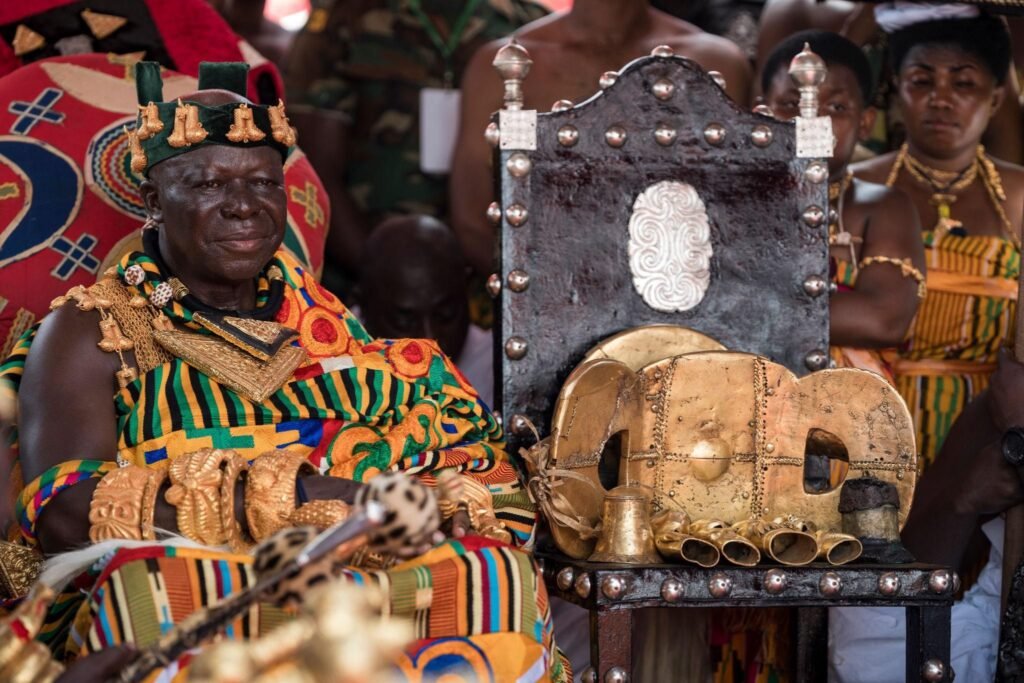
The Asantehene’s court continues anchoring Kente in royal tradition. Otumfuo Osei Tutu II celebrated his Silver Jubilee on May 12, 2024, at Manhyia Palace with elaborate Kente displays. The Akwasidae Festival, observed every six weeks on the Akan calendar, regularly features the king in royal patterns that remain exclusive to his person. In October 2025, the Asantehene donated new Kente cloths to Ghana’s Parliament, replacing those given decades earlier, which had circulated through time and institutions.
When Fashion Speaks the Language of Heritage
The late Virgil Abloh understood something essential about Kente. For Louis Vuitton’s Fall/Winter 2021 men’s collection, the Ghanaian-American creative director reimagined Kente alongside the house’s monogram, creating pieces that sparked immediate debate. When poet Amanda Gorman appeared on Vogue’s May 2021 cover wearing Abloh’s Kente wrapper, the first poet ever featured on the magazine’s cover, the image crystallised complex questions about diaspora, luxury, and authenticity. Abloh’s response was characteristically philosophical: “Provenance is reality; ownership is a myth. We cannot trademark natural or cultural heritage as contemporary artistic territory.”
African designers have engaged with Kente in different inflexions. Christie Brown, the Ghanaian label founded by Aisha Ayensu and named after her seamstress grandmother, has incorporated Kente alongside Ankara and Batik since 2008, dressing dancers for Beyoncé’s Mrs Carter World Tour and earning recognition as Vogue Business’s 100 Innovators in Sustainability. Kente Gentleman, the Ivorian label by Aristide Loua, brought sustainable men’s tailoring to Lagos Fashion Week 2024, with pieces featured in the Fashion Institute of Technology’s “Africa’s Fashion Diaspora” exhibition. Cameroonian designer Imane Ayissi, the first Sub-Saharan designer to show at Paris Haute Couture Week, elevates African textiles, including Kente, into architectural gowns that challenge any notion of “traditional” as a limitation.
The October 2024 Lagos Fashion Week, themed “COMMUNE,” showcased the collaborative spirit animating African fashion. Alongside Kente Gentleman, designers like Ajabeng, Imad Eduso, and Ugo Monye demonstrated how traditional textiles translate into contemporary silhouettes corset styles, jumpsuits, power dresses. Laduma Ngxokolo’s MaXhosa made history as the only Africa-based designer to showcase twice at Paris Fashion Week in 2024, signalling the broader elevation of African textiles in luxury markets.
The Diaspora Claims Its Inheritance
In the early 1990s, something shifted at American universities. Black students began wearing Kente stoles at graduation ceremonies, transforming commencement into a cultural reclamation. The practice, formalised as “Donning of the Kente” ceremonies, originated at West Chester University of Pennsylvania and spread to HBCUs, state universities, and elite institutions alike. Today, schools from Florida A&M to the University of Southern Mississippi host formal Kente ceremonies where students receive handwoven stoles from Ghana, their colours deliberately chosen: black for ancestral union, red for sacrifice and struggle, green for Africa’s fertility, gold for prosperity.
This diaspora connection proved complicated in June 2020, when Democratic lawmakers wore Kente stoles while kneeling for 8 minutes and 46 seconds at the Capitol in honour of George Floyd. Critics, including Nigerian-British author Obianuju Ekeocha, charged cultural appropriation and tokenism. Defenders, including Congressional Black Caucus Chair Karen Bass, emphasised that the cloth signified African heritage and solidarity. The incident illuminated how Kente carries different meanings across communities: a royal Ashanti textile, a pan-African symbol, a marker of educational achievement, and a political statement capable of generating praise and backlash simultaneously.
Amma Prempeh, a BBC journalist and great-granddaughter of Asantehene Agyeman Prempeh I, has worked to bridge these understandings. Her documentary “The Importance of Kente to Ghanaians and Black Africans” premiered in Ghana in August 2023 before touring Harvard Kennedy School, Howard University, the Ghana Embassy in Washington, and UNESCO’s New York office throughout 2024. The film received the Asantehene’s endorsement, speaking across the ocean and generations.
What a Thread Costs in the Marketplace
Authentic handwoven Kente commands prices that reflect labour’s reality. In Ghana, a quality six-yard cloth from Bonwire runs GH₵800 or higher approximately $60-70 at current exchange rates. Premium designs with complex patterns reach GH₵3,500 to GH₵5,000. International buyers typically pay $200 to $800 for authentic pieces, with royal-quality cloths priced at $550 or more. Compare this to printed Kente fabric factory-produced by companies like Vlisco or Akosombo Textile Limited, available at a fraction of the cost, or mass-produced imitations from overseas that undercut everyone.
The differences reveal themselves to anyone who looks closely. Authentic handwoven Kente carries substantial weight with minimal stretch; you can feel each thread’s texture, see the seams where strips join, notice minor variations that attest to human hands. Colours remain consistent on both sides. Printed imitations are lighter, with uniform, repeating patterns and potentially different colours on the reverse. The former lasts for generations, passed down as an heirloom; the latter may fade after washing.
Direct-to-consumer platforms have emerged, connecting diaspora buyers to Ghanaian weavers. Hinkro Kente envisions “plugging Kente into global e-commerce, allowing buyers to order directly from Bonwire to Brixton, Adanwomase to Atlanta.” The new QR authentication system supports this vision scan the code, verify the origin, ensure your purchase supports traditional artisans rather than mass manufacturers.
The Loom Clicks Forward Into Tomorrow
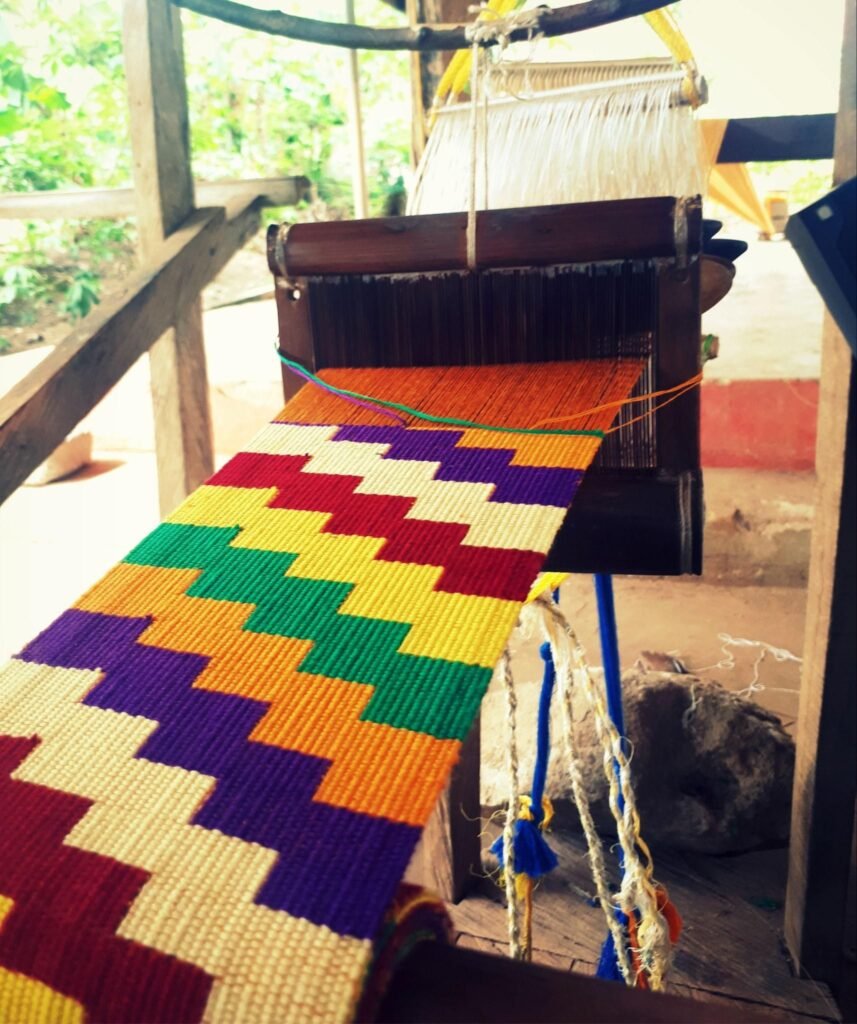
The challenges facing traditional weavers remain substantial. Imported cotton comes at a high cost; intermediaries often dictate prices that reduce artisan margins; young people increasingly prefer office jobs to years of apprenticeship. Ewe weavers report that complex traditional techniques go uncommissioned as customers prefer simpler Ashanti designs. Yet the UNESCO inscription and Geographical Indication status represent genuine opportunities for legal frameworks that could redirect economic flows toward artisan communities.
In Bonwire, master weaver Kwabena Osei-Tutu speaks of protection from mass-produced imitations. In Agbozume, Bob Dennis Ahiagble carries forward his father’s legacy while collaborating with international designers. In Adanwomase, the Tourism Management Team welcomes visitors for workshops, cultural performances, and opportunities to try the loom themselves. The Ahiagble brothers maintain Instagram accounts; Hinkro Kente ships via DHL. Tradition adapts or dies, and Kente weavers are adapting.
What the spider taught those three men in the forest clearing near Bonwire was not merely technique but philosophy: that complex beauty emerges from simple elements repeated with intention, that pattern carries meaning, that cloth can speak. Nearly four centuries later, Kente continues speaking to kings at Manhyia Palace, to graduates crossing stages in Atlanta, to fashion editors in Paris, to anyone willing to learn its language. The cloth that once draped only royalty now wraps the world in colours that remember where they came from. Gold for wealth that flows in every direction. Blue for harmony across distance. Red for the sacrifice that preservation requires. And black is always black for the ancestors watching their inheritance travel further than they ever could have imagined.