
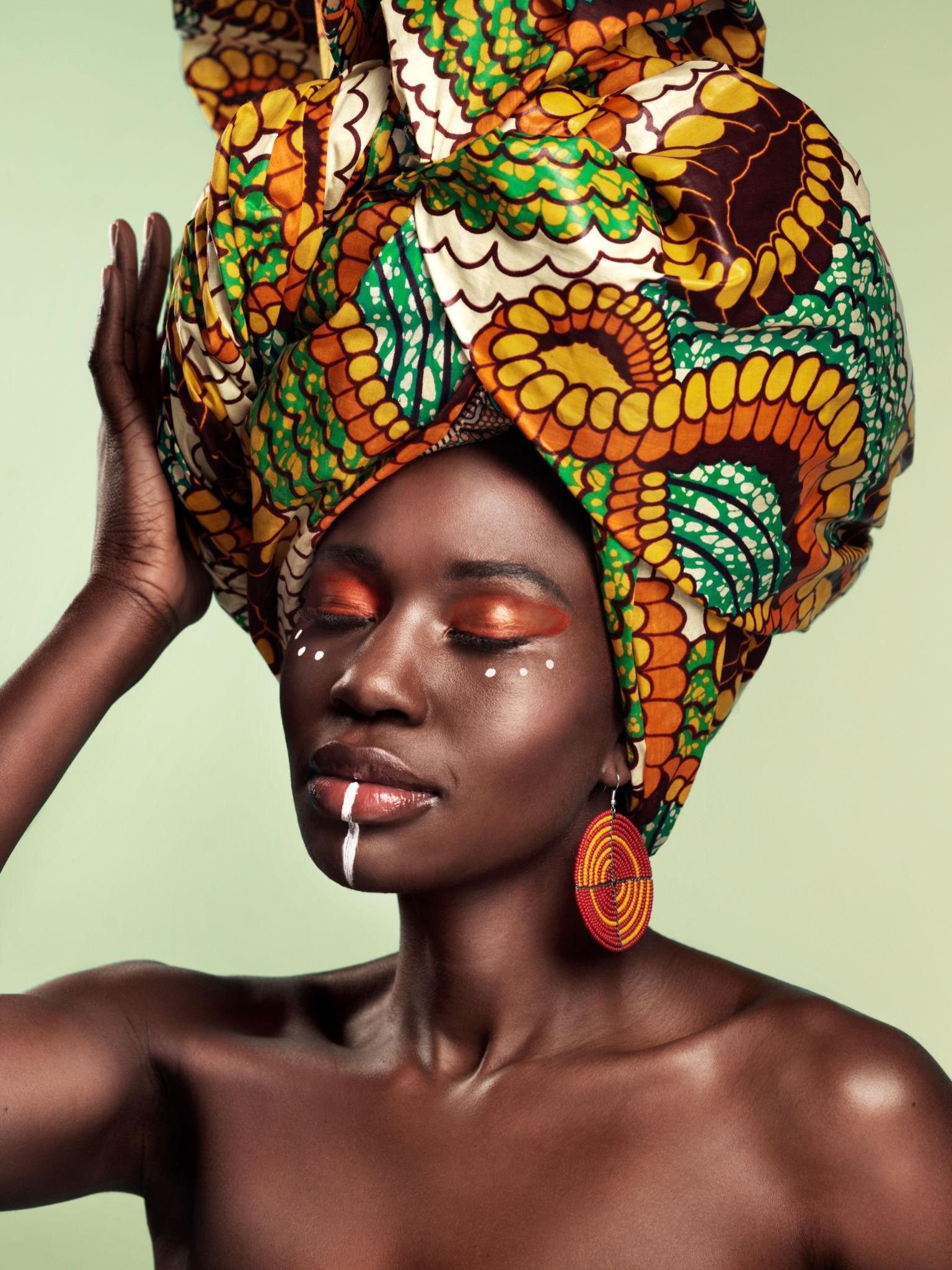
There is a language older than trend cycles in the way fabric meets scalp. It lives in the pause before a knot is secured, in the measured confidence of hands that already know what they are doing. Across Africa and its diaspora, the headscarf is not an accessory that asks for permission. It arrives complete, carrying history, intention, and quiet authority.
Fashion may flirt with it seasonally. African women have always worn it fluently.
The Architecture of Presence

In Nigeria, the gele is not worn. It is constructed.
Towering, sculptural, and entirely unapologetic, the gele transforms the head into a site of ceremony. At weddings, naming ceremonies, and milestone gatherings, its height is a signal of celebration, of status, of a woman prepared to be fully seen. Fabric becomes form. Form becomes announcement. The gele says: I have arrived, and I arrived this way deliberately.
There is engineering inside it. Fabric with memory. Hands with precision. The result is not ornamentation but architecture, the human body as a building, adorned at its highest point with colour and intentional structure.
It belongs to a longer tradition of African design that refuses to separate function from ceremony, labour from beauty, the everyday from the magnificent.
The Duku and the Grammar of Routine Elegance
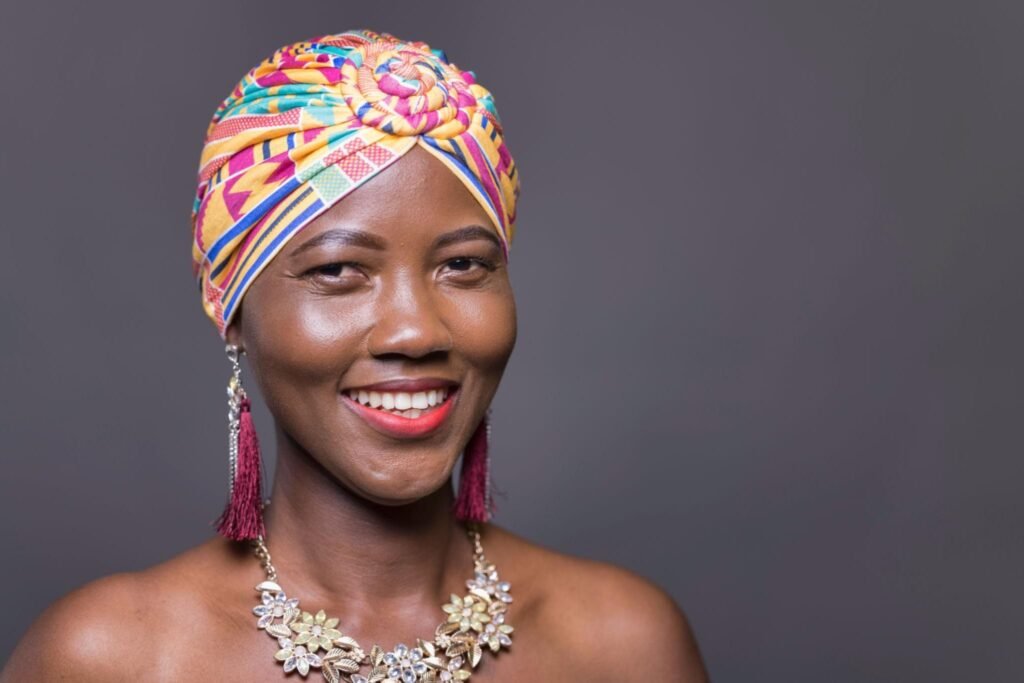
Across Ghana, the duku registers a quieter kind of knowing.
It moves between market mornings and family visits, between long days of work and the soft hour before nightfall. Tied quickly, sometimes without a mirror, it speaks to intimacy rather than spectacle. There is no performance in it. There is simply confidence in the ease of a woman for whom this gesture is as natural as breath.
The duku does not wait for an occasion. It belongs to daily life in the way that language belongs to thought: not decorative, not added on, but structural.
Its patterns carry geography. Its tying styles carry lineage. And its insistence on being present in ordinary moments is its own form of dignity.
Wraps of Practical Grace

In Southern and Central Africa, headscarves are often worn closer to the scalp, prioritising security, softness, and the demands of a long day. Protection from sun, wind, and dust is woven into the aesthetic rather than set against it.
Here, beauty does not compete with function. It moves alongside it, as it always has in African design traditions that never accepted the false division between the useful and the beautiful.
These wraps, like all the others, are read within their communities. They speak of age, marital status, spiritual practice, grief, and joy. They are a visual grammar understood without translation.
Evolution, Not Erasure

In London, Paris, New York, and Toronto, women of the African diaspora are reworking inherited styles through the vocabulary of contemporary wardrobes.
Silk has replaced cotton in some iterations. Bold prints are paired with restrained tailoring. Headscarves are knotted over locs and braids, layered beneath wide-brim hats, or folded into sculptural shapes that carry the logic of the gele while living comfortably beside a winter coat.
What emerges from these cities is not dilution. It is an evolutionary heritage worn with intention rather than nostalgia, anchored in memory but oriented toward the present. Diaspora women are not borrowing from African tradition. They are continuing it, in a different light, on different streets, with the same hands.
The Bandana, the Scarf Braid, and the Currency of Motion
By 2025 and into the current moment, the bandana has re-entered global fashion language with renewed seriousness. Folded into triangles and tied low at the nape, worn as a loose headband across box braids, or knotted at the crown with deliberate carelessness, it signals ease without apology.
The scarf braid dissolves the border between hair and fabric entirely, allowing colour to move with the body rather than sit above it. These styles are made for motion for head turns, for walking into rooms, for the moment when someone pauses and looks again.
What international runways have recently rediscovered, African women across the continent and the diaspora never set down. The bandana, in its current global moment, is simply returning to its original audience.
Crowns, Bows, and the Politics of Height
Some wraps refuse to be quiet.
Sky-high knots, oversized bows, and crown-like constructions recall ancient African headwrap traditions in which elevation was not a matter of vanity but of vocabulary. Height signified presence. It marked spiritual authority, social standing, and the right to be seen clearly and from a distance.
Contemporary iterations of these forms, worn in Lagos boardrooms and Accra art spaces, in London galleries and Nairobi supper clubs, carry that inheritance forward. They are not theatrical. They are declarative. They say something specific about who is wearing them and what they have decided about themselves.
A woman in a crown wrap has not borrowed confidence from the wrap. She has simply made it visible.
What Has Never Been Forgotten
What connects these styles across regions, generations, and geographies is intention.
The headscarf is never neutral. It frames identity, signals belonging, and allows women to claim space on their own terms without explanation, without justification, without waiting for the culture cycle to catch up with what was already known.
Its capacity to hold so many meanings simultaneously, ceremony and labour, protection and proclamation, memory and reinvention, is not a contradiction. It is the full range of what African women have always been, and how they have always insisted on being seen.
Fashion may rediscover the headscarf each season, wrapping it in new language and new contexts. African women have never needed that permission.
They have simply continued, each morning, to tie the knot.